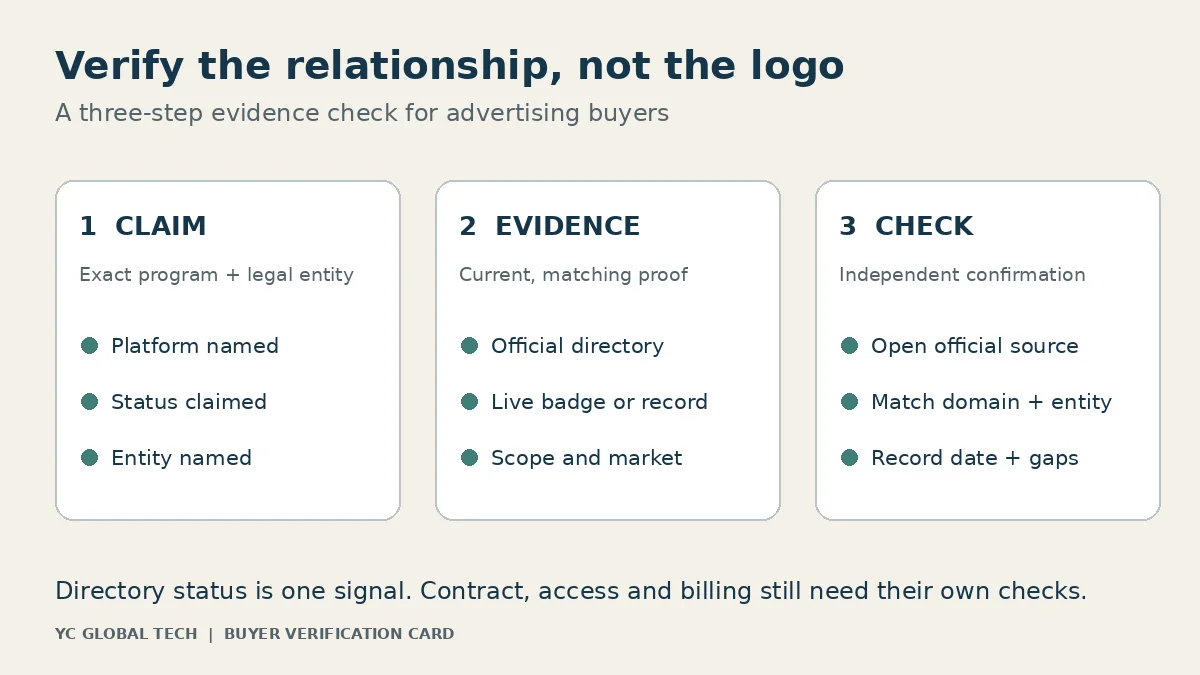
Short answer: Turn “we are an official partner” into a precise statement: which platform program, which legal entity, what current status and what service scope? Then check an official directory or platform-controlled record, match it to the supplier’s domain and contracting entity, and keep any gap marked unresolved. A logo in a proposal is not independent evidence.
Buyers often ask the wrong yes-or-no question: “Are you a partner?” The useful question is whether the relationship being claimed applies to the company, market and service you are actually buying. That distinction matters because platforms operate several partner programs, badges can refer to different specialties, and an agency may contract through a different entity from the brand shown on its website.
Ask the supplier to complete one sentence in writing:
[Legal entity] claims current [program name and status] with [platform] for [service specialty and markets]. The official verification route is [directory or platform-controlled URL]. The status was checked on [date].
If the answer is only “certified,” “authorized” or “top-tier,” ask what those words mean. A staff certification, a company listing and a commercial reseller arrangement are not interchangeable. Do not infer account availability, pricing, credit terms, support priority or policy exceptions from a badge.
A mismatch can have an ordinary explanation, such as a trading name or group company. The buying task is to document that explanation and decide whether the remaining risk is acceptable. Do not publish allegations or assume fraud from one missing directory result.
Supplier brand: [name]
Contracting entity: [legal name / registration details]
Platform claim: [exact words used]
Program and specialty: [name]
Official directory result: [URL / not found / not publicly listed]
Website and country match: [yes / no / explanation]
Quote and invoice entity match: [yes / no / explanation]
Account access promised: [role and owner]
Billing and payee: [entity and currency]
Escalation route: [supplier / upstream / platform]
Checked by and date: [name / date]
Decision: [verified for stated scope / unresolved / rejected]
Keep screenshots only as dated records; always preserve the live official URL as the primary check. If the platform offers no public directory for the specific claim, ask for a verification method the platform controls or obtain a written explanation of the chain. “Not publicly verifiable” is a valid record state.
Google describes its Partners program as serving agencies and third parties that manage Google Ads accounts. TikTok says its badged partners are evaluated within defined solution categories. These are useful first-party signals. They do not replace the buyer’s review of the contract, fees, permissions, data access, balance handling or exit terms.
For the next step, use our supplier evidence checklist, compare commercial terms with the total-cost worksheet, and send suppliers the same ad-account RFQ.
Evaluating selected media access and account operations? Send YC your website, platform, target markets, planned spend and the exact support you need. See our native-media access overview. We will not treat a badge as a promise of account approval, availability, pricing or campaign results.
Prepared by YC Global Tech. Sources checked on 6 October 2026. This verification card is an editorial procurement tool, not legal advice or a platform endorsement.