
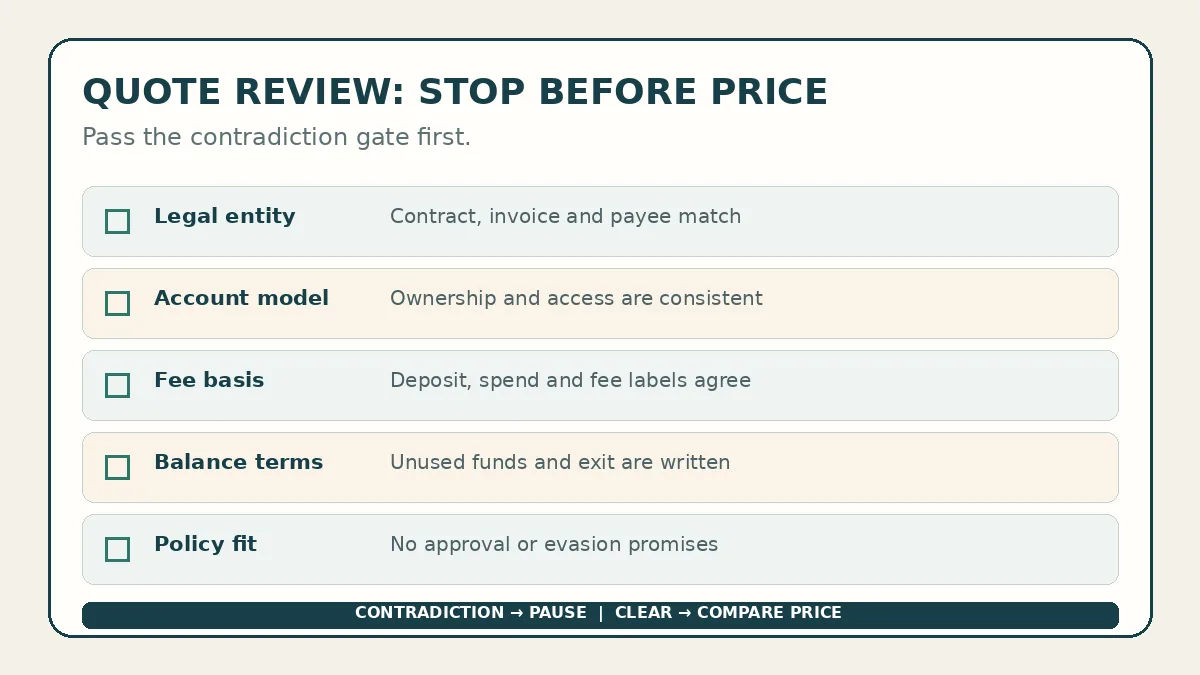
The cheapest quote is irrelevant if the contracting entity, account model, payee, fee basis, or exit terms contradict each other. Before discussing price, run a pass-or-pause review. The purpose is not to label a supplier “bad.” It is to stop commercial comparison until the buyer can understand what is actually being offered.
A rejection at this stage can be temporary. “Pause pending clarification” is often the right answer. But unresolved contradictions should never be converted into assumptions simply to keep a deal moving.
Pass one checks whether the offer is coherent. Pass two compares cost and value. A quote only reaches the second pass when the service chain, access model, money flow, and written terms tell the same story.
This order matters because a supplier may quote a low service fee for an arrangement that gives the buyer no usable access, invoices through an unexplained entity, or calculates charges on a different basis from the one used in the sales message.
| Gate | Pass | Pause or reject |
|---|---|---|
| Legal entity | The quote, contract, invoice issuer, and supplier explanation identify the relationship. | The brand name and contracting entity differ with no written explanation. |
| Account model | The quote states who owns or creates the account and what role the buyer receives. | The supplier calls the account “yours” but cannot explain ownership, linking, or removal. |
| Access | Permissions match the work the buyer must perform. | Campaign control is promised, but the named role is reporting-only or remains unspecified. |
| Fee basis | Each fee says whether it applies to deposits, eligible spend, invoices, or another defined base. | The same charge is described against different bases in the quote and sales conversation. |
| Funding and balance | The payee, currency, reconciliation, and unused-balance treatment are written. | Payment is requested before the payee or remaining-balance obligation is explained. |
| Policy and approval | Eligibility and platform decisions are described as conditions. | The supplier promises policy immunity, guaranteed approval, or a way around enforcement. |
| Exit and escalation | The quote identifies who handles issues and what happens to access, data, and funds at exit. | The sales contact cannot identify the responsible entity or the termination path. |
Platform structures make this distinction important. Google says users can be granted, edited, or removed from an Ads account. Its manager-account guidance also explains that manager ownership does not take data ownership away from the client account, and that ownership privileges should be enabled only when needed. TikTok separates requesting access from owning an account and defines Admin, Operator, and Analyst permissions.
If the supplier uses “owner,” “admin,” “manager,” and “operator” interchangeably, ask it to map its wording to the platform’s actual role. A contradiction here can affect billing, data access, offboarding, and the buyer’s ability to operate campaigns.
Please reconcile the following points before we compare commercial price:
1. Contracting entity and invoice issuer: [state both]
2. Account owner and buyer access role: [state both]
3. Fee and rebate calculation bases: [define each]
4. Payee, funding currency, and unused-balance terms: [state each]
5. Escalation and exit responsibility: [state the responsible entity]
Ask the supplier to answer by editing the quote or attaching a written schedule. A chat reply can help, but the final commercial document should contain the terms the finance and operations teams will rely on.
A different trading name, an intermediary, or a higher price is not automatically a red flag. Each may be acceptable when the chain and value are documented. Likewise, a supplier may need upstream confirmation before committing to availability or timing. “Not yet confirmed” is more credible than a guarantee the supplier cannot control.
Google’s third-party transparency rules illustrate the standard buyers should expect: advertising costs should be distinguished from third-party fees, and management fees should be disclosed in writing and on customer invoices. Use that principle across the quote even when the proposed service involves another platform.
After the quote passes the contradiction gate, normalize it with the total-cost comparison worksheet. Verify the supplier with the supplier evidence checklist and capture missing terms through the buyer RFQ template.
Need a quote reviewed against your operating requirements? Send YC Global Tech your platform, markets, account model, and funding workflow. We will separate confirmed terms from unresolved conditions without inventing availability, price, or approval outcomes.
Sources checked 8 October 2026. This is a procurement review tool, not legal or tax advice.