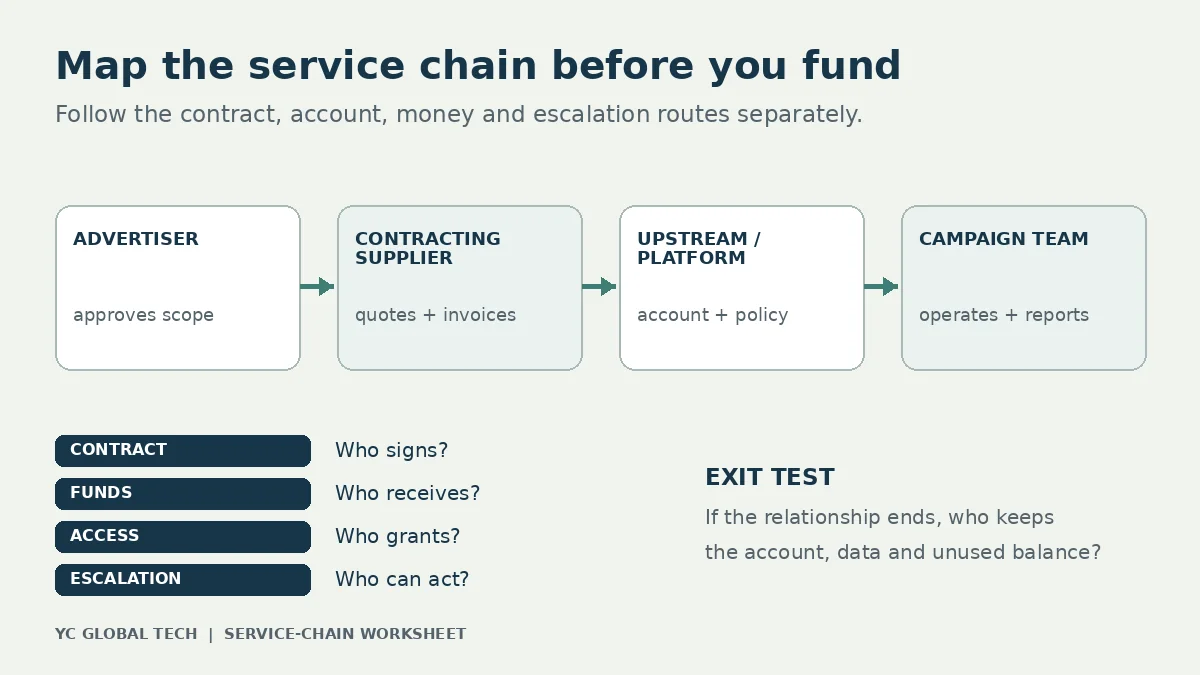
Short answer: “Direct” is not automatically safer, and “intermediary” is not automatically worse. The risk comes from an unclear chain. Before funding, identify the contracting supplier, account owner, payee, upstream provider, campaign operator and person who can escalate a platform issue. Then test what happens if the relationship ends.
Advertising procurement often compresses several roles into one word: agency. One company may sell the service, another may provide the platform relationship, a third may invoice or hold credit, and your own team may run the campaigns. If those paths are not mapped, a buyer can discover too late that the person answering support tickets cannot change billing or restore account access.
Official platform documentation shows why these routes can differ. TikTok Business Center distinguishes accounts owned by the Business Center from accounts owned by a partner, and allows partners to receive specific permissions. Google Ads manager-account documentation distinguishes account management, administrative access and billing relationships. These structures are normal, but the buyer should know which structure is being proposed.
Advertiser legal entity: [name]
Contracting supplier: [name / country]
Supplier role: [direct platform relationship / reseller / sub-agency / operations only]
Upstream provider: [name or “not disclosed,” with reason]
Platform and account ID owner: [entity]
Buyer access at launch: [admin / operator / analyst / reporting / none]
Campaign operator: [buyer / supplier / third party]
Invoice issuer and payee: [entity]
Platform payer or credit holder: [entity]
Unused-balance obligation: [who owes whom, subject to which terms]
Routine support owner: [name / channel]
Escalation path: [supplier → upstream → platform]
Termination path: [access, data, account, balance and open invoices]
Mark each answer as contracted, evidenced, stated or unknown. “Stated” means the supplier has answered, but the promise is not yet in the contract or independently supported. This keeps a buyer from treating a sales call as an enforceable term.
If the supplier says the relationship is direct, ask what “direct” refers to. It might mean a direct platform contract, direct account administration, direct invoicing or simply that no additional sales broker is involved. Verify the exact platform program separately and match it to the legal entity.
A direct relationship can shorten escalation and reduce handoffs, but it does not prove good pricing, suitable access or platform approval. Compare the actual service and total cost rather than paying for a label.
An intermediary may add useful local billing, funding coordination, language coverage or day-to-day operations. Ask what work it performs and what depends on the upstream agency. If the upstream provider must remain confidential, require enough written detail to understand account ownership, payment liability, access and escalation dependencies.
Do not send funds until the payee and invoice issuer match the agreed chain or the difference is documented. If the intermediary collects money, the contract should explain who owes the advertiser an unused balance and what conditions apply. Do not assume the platform owes a refund simply because the money ultimately funds advertising.
TikTok documents that Business Center admins can grant and remove partner access, while ownership and transfer options depend on the account structure and customer eligibility. Google documents that a client or manager admin can unlink a manager relationship. Use platform controls where available; do not share personal logins as a substitute for role-based access.
If your team only needs funding and invoices, do not automatically buy campaign management. If you need hands-on buying, name the operator and reporting standard. More parties can add capability, but every handoff should have an owner, a response route and a documented commercial reason.
Pair this map with our platform-relationship verification guide, the total-cost comparison and the copyable RFQ brief.
For selected media-access and account-operation requests, send YC your advertising entity, website, platform, target markets, planned spend and required access. Review our native-media access overview. Eligibility, account structure, service scope, fees and timing must be confirmed for each arrangement.
Prepared by YC Global Tech. Sources checked on 6 October 2026. The service-chain map is an editorial procurement tool, not legal advice or a promise of platform support.