
Finance should not receive an ad account payment request as a screenshot and a bank detail. A cross-border media purchase needs a document trail that connects the supplier, contract, invoice, payee, account arrangement, and later reconciliation.
The exact tax and regulatory requirements depend on the buyer’s country, the supplier entity, and the service structure. The pack below is a procurement workflow, not a substitute for local accounting or legal advice.
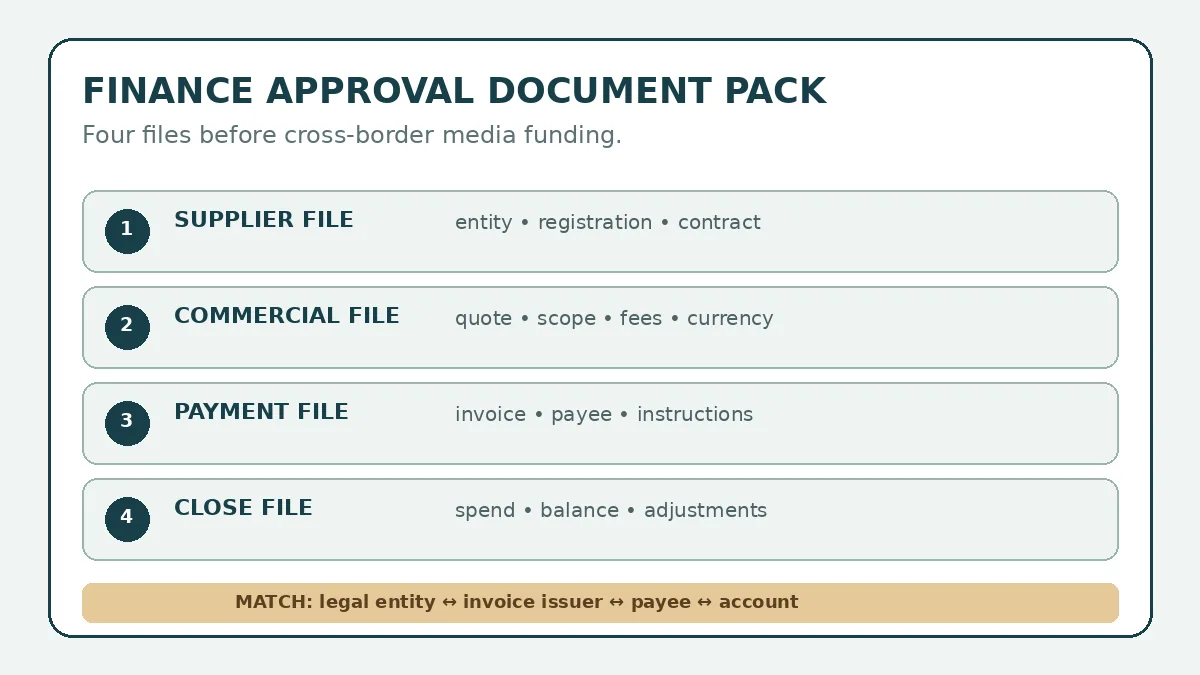
Keep the supplier’s legal name, registration jurisdiction, business address, contracting contact, registration evidence appropriate to your process, and the website or trading name used in the sale. If the quote uses a brand but the contract uses a legal entity, record the relationship.
Also identify any upstream agency, platform, or collection entity that changes the service or money flow. An intermediary is not automatically unsuitable, but finance needs to know which entity owes each obligation.
Store the signed contract or accepted order form, final quote, service scope, platform and markets, account model, access rights, billing currency, fee labels, rebate or credit conditions if applicable, unused-balance terms, and termination process. Separate media funding from account operations, campaign management, creative work, and other services.
Google’s third-party transparency requirements provide a useful benchmark: Google advertising charges should be reported separately from third-party charges, and management fees should be disclosed in writing and on customer invoices. Even when buying other media, finance should be able to identify the media amount and the supplier’s own charges.
Before releasing funds, match four fields: contracting entity, invoice issuer, payee name, and the entity described in the payment instructions. If one differs, require a written explanation and approval under the buyer’s own controls.
| Document | Fields to match | Question if different |
|---|---|---|
| Contract or order form | Supplier entity, service, currency | Who is contractually responsible? |
| Invoice | Issuer, buyer, description, amount, currency | Does the invoice match the approved scope? |
| Payment instructions | Beneficiary, account, currency, reference | Why is this payee receiving the money? |
| Internal approval | Budget owner, account reference, approver | Which campaign or account will receive the funds? |
Use a known contact and agreed channel to verify changed payment instructions. Do not rely only on a forwarded email or chat message. Keep credentials, authentication codes, and payment-card details outside the procurement pack.
After payment, keep the transfer confirmation, supplier receipt or cleared-funds confirmation, funding allocation record, platform or account balance evidence available to the buyer, spend report, adjustments, credits, supplier invoice, and closing balance.
Google explains that the billing document available depends on payment method and billing country. Its account documents may include invoices, statements, or receipts; statements distinguish starting balance, new activity, adjustments, payments received, and ending balance. That structure is a useful model for an agency-supported account reconciliation, but a supplier document should not be presented as a platform-issued document.
Buyer entity: [name]
Supplier legal entity: [name / jurisdiction]
Trading name: [if different]
Contract or order reference: [reference]
Platform and account model: [details]
Invoice issuer: [name]
Payee / beneficiary: [name]
Payment currency and amount: [details]
Media funding amount: [details]
Supplier fees and taxes: [separate lines]
Unused-balance terms: [clause]
Account or campaign reference: [reference]
Budget owner / finance approver: [roles]
Reconciliation owner and date: [details]
Open exception: [none / explain]
An exception does not always mean stop permanently. It means finance should understand and approve the chain before payment. The supplier’s urgency should not replace the buyer’s controls.
Share the account owner, buyer access role, and funding reference with both finance and the media buyer. Google allows user access levels to be checked and changed; TikTok defines Admin, Operator, and Analyst roles. The role named in the commercial file should match the buyer’s actual operating need.
Use the ad account RFQ to collect terms, the service-chain map to identify entities, and the quote comparison before approval.
For selected media-account requirements, send YC Global Tech your website, platform, target markets, planned monthly spend, and required billing workflow. Final eligibility, fees, payee instructions, and timing are confirmed for the individual arrangement.
Sources checked 8 October 2026. Confirm local tax, accounting, foreign-exchange, and documentation requirements with qualified advisers.