
“A 3% service fee” is an incomplete quote. Three percent of the money transferred, the net amount credited, or the media cost consumed? The answer changes the charge even if the headline rate stays the same.
There is no universal fee basis for every advertising supplier. Ask for the base, rate, timing and collection method in writing. Then compare offers using the same deposit and spend assumptions. This guide isolates the fee calculation; the total-cost guide covers the broader quote.
| Quoted basis | What to define | Buyer question |
|---|---|---|
| Deposit or funding received | Gross sent amount, cleared receipt or net funding allocation | Is the fee charged before any ads run? |
| Actual media spend | Reporting period and included or excluded cost lines | Which finalized report establishes the base? |
| Invoice or service amount | Whether the base includes media, taxes or other fees | Am I paying a percentage on another charge? |
The supplier may use a fixed fee or a minimum instead of, or alongside, a percentage. Record that separately. A percentage alone does not describe the service scope or prove one offer is cheaper.
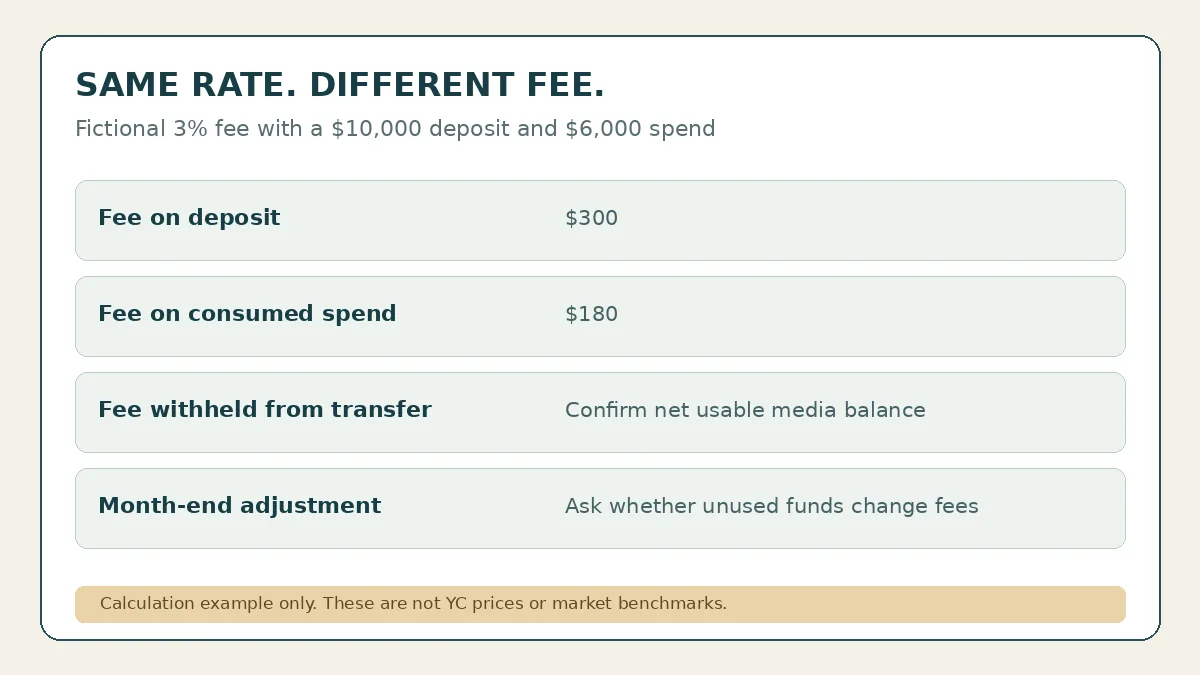
For illustration only, assume $10,000 is deposited and $6,000 is consumed during the month. Both fictional quotes charge 3%, with the fee invoiced separately and no minimum, tax, FX cost or other charge.
| Offer | Calculation | Fee for this month |
|---|---|---|
| Fee on deposit | $10,000 × 3% | $300 |
| Fee on consumed spend | $6,000 × 3% | $180 |
The difference is $120 for this period. It is not necessarily a permanent saving: if the remaining $4,000 is consumed later, the spend-based arrangement may charge another $120 then. Under the deposit-based model, ask whether later use of that same funding triggers another charge. Avoid assuming either answer.
If a fee is added to a $10,000 media deposit, the buyer pays media funding plus the fee. If a fee is withheld from a $10,000 transfer, the amount credited for ads is lower. The supplier must state which amount its percentage uses.
A fictional 3% deduction from the gross $10,000 receipt leaves $9,700 for media. A fee equal to 3% of the net media amount is a different calculation: media funding is $10,000 ÷ 1.03, approximately $9,708.74, and the fee is approximately $291.26. These are arithmetic examples, not YC terms or suggested rates. Ask for the usable media amount rather than inferring it from “3%.”
Supplier / quote version: [ ]
Service included: [ ]
Currency / reporting period: [ ]
Fee name and rate: [ ]
Exact calculation base: [ ]
Deposit assumed: [ ]
Consumed spend assumed: [ ]
Included taxes, credits or adjustments: [ ]
Minimum or fixed charge: [ ]
Fee added or withheld: [ ]
Net media funding available: [ ]
Fee invoice date / due date: [ ]
Unused-funds or refund treatment: [ ]
Month-end true-up and evidence: [ ]
Repeat charge on already funded money: [ ]
Get the answers in the final quote or fee schedule. A verbal percentage does not settle these scenarios. Compare a low-spend month and a month where the deposit is fully consumed before approving a recurring arrangement.
Google requires third parties charging management fees to disclose them to new customers in writing before the first purchase and on customer invoices, separately from Google advertising costs. That requirement does not prescribe a fee percentage or a deposit-versus-spend basis. Use clear disclosure as the benchmark while confirming the actual contract.
Bring the fee worksheet together with the two-ledger reconciliation and buyer RFQ. Send YC your platform, markets, website and funding assumptions to request a quote with an explicit service scope and fee basis. Final terms are confirmed individually.
Google third-party transparency requirements, checked 9 October 2026. Calculations and worksheet are original illustrative procurement tools.